

This guide provides the essential logistical foundation for any first-time traveler to the African safari circuit, covering documentation, health, preparation, and key destinations.
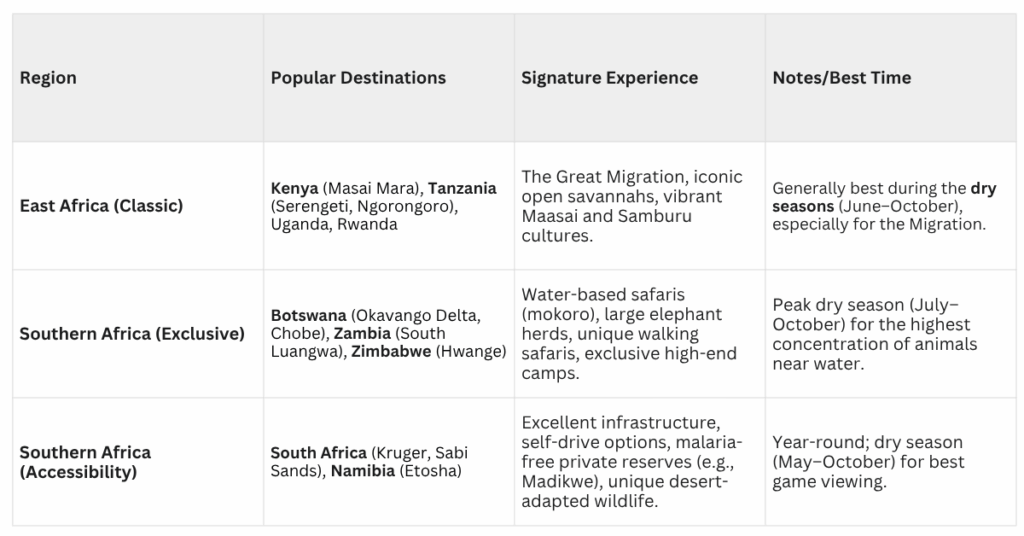
The “Big Four” safari regions offer distinct experiences. Kenya and Tanzania are often grouped as classic East African safari options, renowned for their landscapes and high wildlife concentrations.
Your passport must be valid for at least six (6) months beyond your intended departure date and have at least two (2) blank pages for entry stamps.
Most major safari countries require an electronic visa or entry permit (e-Visa/ETA) applied for before arrival.
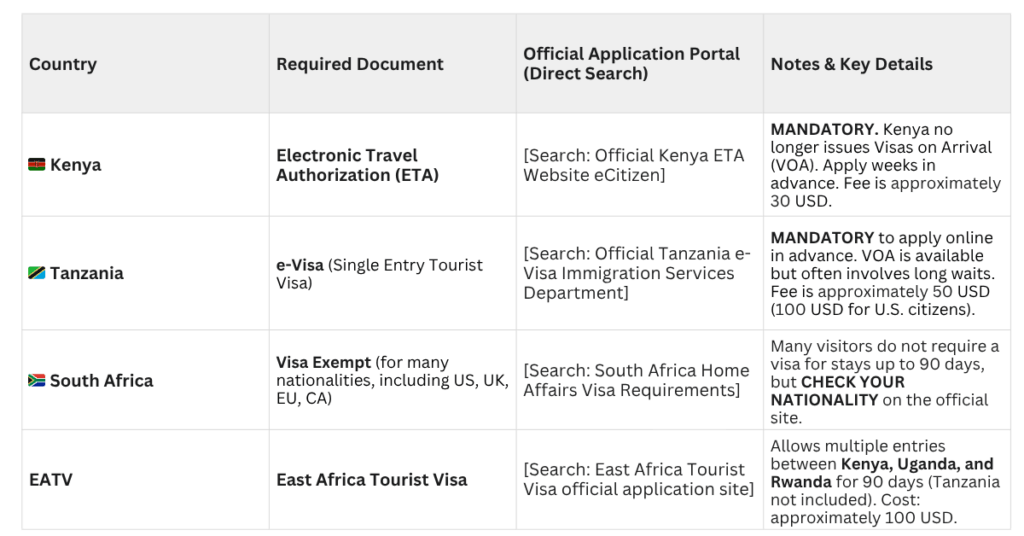
⚠️ IMPORTANT WARNING: Always use the official government websites for visa/ETA/e-Visa applications. Unofficial third-party sites often charge significantly inflated fees for the exact same document.
Consult a travel health specialist at least 6-8 weeks before your trip.
Yellow Fever Certificate: Mandatory if you are arriving from a country with a high risk of Yellow Fever transmission. This includes transit through an endemic country (even if you don’t leave the airport). Kenya and Tanzania enforce this strictly, especially at border crossings.
Resource Check: [Search: WHO Yellow Fever Endemic Countries List]
Recommended Vaccines:
Hepatitis A & B
Typhoid
Tetanus/Diphtheria/Polio (Routine)
Malaria is present in most safari areas (including the main parks in Kenya and Tanzania).
Prophylaxis: Speak to your doctor about prescription anti-malarial medication (e.g., Malarone, Lariam, Doxycycline). Start taking it before you enter the risk zone and continue after you leave, as directed.
Physical Protection: Use insect repellent with a high concentration of DEET, wear light-colored, long-sleeved shirts and long trousers at dawn and dusk, and sleep under mosquito nets where provided.
Mandatory for all safaris. Your policy must cover:
Emergency Medical Care: Hospitalization and treatment.
Emergency Evacuation: Ground and/or air evacuation from a remote safari camp to a major medical facility (e.g., Nairobi, Johannesburg).
Trip Cancellation/Interruption: For unforeseen events like illness, delayed flights, or political instability.
Luggage: For fly-in safaris (using small charter planes), soft-sided duffel bags are mandatory due to strict weight limits (often approximately 15kg to approximately 20kg total).
Clothing:
Colors: Pack neutral, earthy colors (khaki, olive, brown, beige). Avoid bright colors (which can startle wildlife) and black/dark blue (which can attract tsetse flies).
Layers: Days are hot, but early morning and evening game drives are very cold. Pack a warm fleece, jacket, and a beanie/gloves.
Footwear: Comfortable, closed-toe walking shoes or sturdy trainers. Sandals for camp.
Essentials:
Binoculars: High-quality optics (8×40 or 10×42 are common) are essential for wildlife viewing.
Sun Protection: Wide-brimmed hat, high SPF sunscreen, and sunglasses.
Camera Gear: Camera with a telephoto lens, extra memory cards, and extra batteries/power bank.
Health: Personal first-aid kit, prescription medications (with copies of prescriptions), and DEET-based insect repellent.
Adaptors: Type G (UK style, used in Kenya/Tanzania) or Type D/M (Southern Africa) depending on your itinerary.
Request A Free Quote